BREAKINGJ6 COMMITTEE EXPOSED: New Findings Reveal The J6 Committee
Posted November 20, 2025
The sham January 6 Committee, formed under the guise of seeking truth, has now been exposed for what it truly was: a partisan hit job that wasted over $17 million of taxpayer money. This is more than twice the amount Congress initially authorized for its operations.
The committee, stacked with anti-Trump partisans like Liz Cheney and Adam Kinzinger, burned through funds at a shocking rate, largely on public relations, partisan consulting, and staging made-for-TV spectacles.
According to recently disclosed budget figures, the committee’s final expenditure was $17.1 million, up from the original $8.2 million budget. No meaningful legislative reforms emerged from this money pit.
The majority of that money went to legal fees, media production, and staff salaries. Records reveal millions spent on Democratic-aligned firms for public relations, including one that also worked for Joe Biden’s 2020 campaign.
“This wasn’t an investigation. It was a political show trial,” said Rep. Byron Donalds. “And now we know how much the circus cost.”
Among the absurd expenditures were payments to high-priced media consultants who scripted hearing narratives and coached witnesses. It was not about justice, it was about optics.
The committee’s much-hyped primetime hearings cost American taxpayers nearly $3 million alone, much of which was used to stage dramatic entrances and choreographed opening statements.
Even CNN analysts admitted the hearings resembled “a Netflix political docuseries,” rather than a congressional probe.
None of the funds went to Capitol security upgrades. Instead, it was funneled into pushing a narrative that blamed Donald Trump for an event he neither organized nor incited.
The final report issued by the committee included no criminal referrals that stood the test of independent scrutiny. Most were political grandstanding with zero prosecutorial value.
The Biden Justice Department has not prosecuted a single additional case based solely on the committee’s findings, which further undermines its legitimacy.
“They had one job, and they failed,” said Rep. Matt Gaetz. “All they did was write scripts and smear Trump supporters.”
Meanwhile, the real issues of security failures and possible FBI entrapment remain untouched. The committee refused to subpoena Nancy Pelosi or review Capitol Police communications.
Critics also question how the committee justified hiring nearly 80 full-time staff, many of whom were Democratic operatives, to work on a probe with so little actual investigative substance.
Several of these staffers have since landed jobs with liberal think tanks and MSNBC, prompting accusations that the committee was a career-launching platform for the anti-Trump elite.
The waste is not just financial, but constitutional. The committee trampled due process, aired selectively edited footage, and denied Republican cross-examination.
Legal scholars on both sides have criticized the committee’s use of closed-door testimony, lack of transparency, and coordinated media leaks.
“We still don’t have access to the full 14,000 hours of surveillance footage,” noted Rep. Marjorie Taylor Greene. “What are they hiding?”
The answer appears to be that the committee wasn’t interested in truth—it was interested in 2024. Every action was calculated to paint Trump and his supporters as domestic enemies.
In doing so, they diverted attention from real crises: rising crime, border chaos, and economic collapse under Joe Biden.
Despite spending nearly $20 million, the committee failed to shift public opinion. Trump remains the GOP frontrunner, and J6 prosecutions have backfired politically.
As oversight Republicans now dig into the committee’s finances, subpoenas may follow. There are calls to audit every dollar spent.
“We want receipts,” said Rep. Elise Stefanik. “The American people deserve to know how their money was used to fund a witch hunt.”
Republicans GAIN House Seat in Unexpected Development — The Left is Reeling
North Carolina’s Republican-led legislature approved a revised congressional district map designed to add at least one more GOP seat in the U.S. House, aligning with President Donald Trump’s push for mid-decade redistricting to help Republicans maintain their narrow majority in the chamber ahead of the 2026 midterm elections.
The new boundaries build on the state’s existing map, drawn by Republicans in 2023 following the 2020 census, which delivered 10 of North Carolina’s 14 House seats to the GOP in the 2024 elections—even as the swing state remains evenly split between Republican and Democratic voters.
Democratic Gov. Josh Stein lacks veto power over redistricting under state law, leaving the plan poised for implementation unless challenged in court.
This move marks the third instance this year of a Republican-controlled state legislature responding to Trump’s call for aggressive redistricting strategies, following similar actions in Texas and Missouri.
In Texas, where the push began in earnest, Republicans unveiled a proposed map on July 30, 2025, aiming to flip up to five Democratic-held seats through mid-decade adjustments.
The effort stems from a pair of long-running legal battles, including a 2024 ruling by the U.S. 5th Circuit Court of Appeals that overturned prior district configurations in areas like Baytown and Galveston, creating an opening for the redraw.
Texas Republicans have cited population shifts and compliance with voting rights laws as justifications, though critics argue it’s a partisan power grab encouraged by Trump. By September 2025, state officials had begun walking back some initial rationales amid scrutiny from the U.S. Department of Justice, but the plan remains on track for adoption.
Other GOP-led states, including Ohio, Kansas, and Indiana, are weighing or advancing comparable mid-cycle changes, capitalizing on their legislative majorities to redraw lines outside the traditional decennial census timeline. Such tactics have historical roots.
Texas itself pursued a similar mid-decade redistricting in 2003 under then-Gov. Rick Perry, who helped solidify Republican dominance in the state’s delegation.
Democrats have decried these efforts as unfair gerrymandering, but Republicans counter that many blue states have long employed similar strategies to entrench their own advantages.
For instance, Illinois Democrats have drawn maps that pack Republican voters into a handful of districts, allowing the party to hold a supermajority in the state’s congressional delegation despite competitive statewide races.
In Maryland, convoluted district shapes have helped Democrats secure seven of eight House seats in a state where Republicans routinely win about 40% of the vote.
New York Democrats attempted an aggressive gerrymander in 2022, only to have it struck down by courts, but the episode highlighted ongoing partisan map-drawing in left-wing strongholds.
Overall, both parties have a history of manipulating districts for gain, with gerrymandering often canceling out nationally but distorting representation at the state level.
In response to the Republican surge, California Democrats have placed Proposition 50 on the November 2025 ballot, a measure that would authorize temporary congressional map changes through 2030 to counter moves in Texas and other red states.
The proposition, backed by Gov. Gavin Newsom and the state Democratic Party, directs the independent Citizens Redistricting Commission to adopt legislatively influenced boundaries, potentially putting five Republican-held seats at risk in districts currently represented by figures like Reps. Kevin McCarthy and Mike Garcia.
With Republicans controlling more state legislatures than Democrats, the GOP appears positioned to net additional House seats through these maneuvers.
Democrats, who fell short in 2024, need to net just three seats to reclaim the House majority in 2026, making every district adjustment critical.
The Senate remains a tougher climb for Democrats, who must defend incumbents in red-leaning states while targeting GOP vulnerabilities.
U.S. Rep. Don Davis, a North Carolina Democrat, blasted the plan as “beyond the pale” in a statement, accusing Republicans of undermining fair elections as his 1st District faces elimination under the new map.
Trump, however, hailed the North Carolina map on social media, calling it a win for “putting America First.” State House Speaker Destin Hall echoed the sentiment by reposting Trump’s message, adding, “We’re putting America First in NC!”
As legal challenges mount and the redistricting arms race intensifies, the 2026 midterms could hinge on these behind-the-scenes battles over district lines, testing the resilience of America’s electoral system.
THE MOST EMOTIONAL NIGHT OF HIS CAREER
There are concerts that entertain. There are concerts that energize. And then… there are concerts that become stories — the kind told years later, retold in whispers and wide-eyed wonder because something extraordinary happened on that stage.
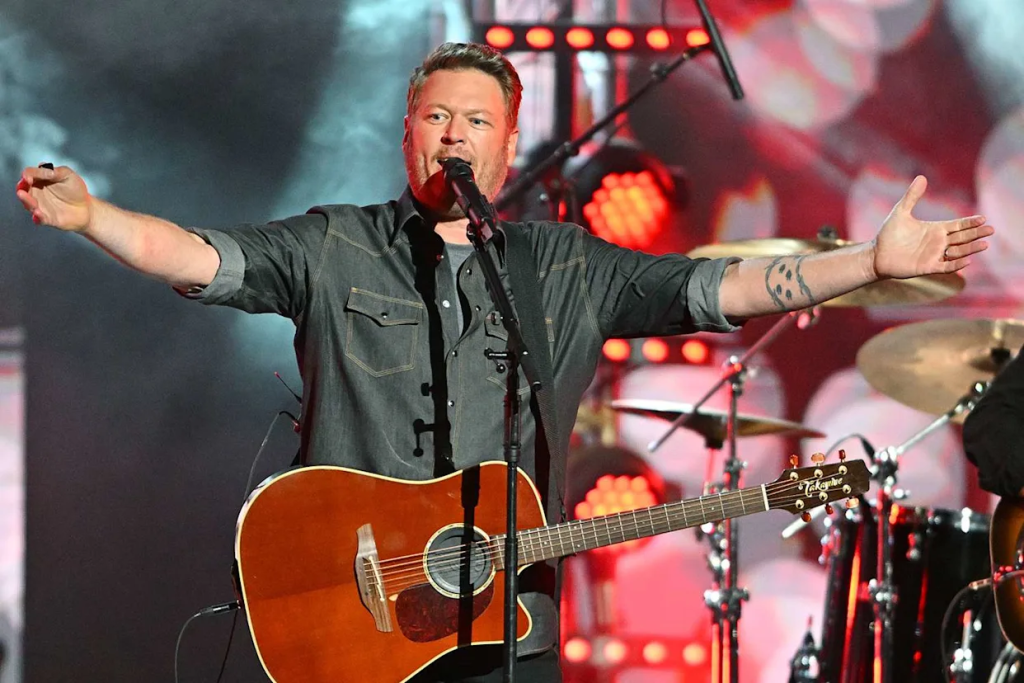
On one remarkable night, during a sold-out arena show filled with golden lights and thunderous applause, Blake Shelton stepped into a moment he would never forget — a moment that transformed an ordinary performance into one of the most emotional nights of his entire career.
It began quietly. Soft guitar. Warm stage glow. A sea of fans holding their breath as Blake eased into one of his most beloved songs: “God Gave Me You.”
But what happened halfway through the song stunned the entire arena… and left Blake Shelton visibly moved in a way few people had ever seen.
THE GOLDEN STAGE — AND A SONG WITH HISTORY
The stage that night looked like something from a dream. A soft halo of golden light shimmered across the stadium, reflecting off the instruments, the mic stand, and Blake’s familiar silhouette in his dark denim and acoustic guitar.
Fans lifted their phone flashlights in unison as soon as the opening chords played, transforming the audience into a glowing field of white stars.
Blake smiled — that warm, genuine smile fans know so well — before leaning toward the mic, eyes closed, singing the opening lyric with the quiet confidence of a man who has lived every word.
“I’ve been a walking heartache…”
The crowd sang along softly, almost reverently, as if the moment were sacred.
“God Gave Me You” has always been more than a song. It’s a lifeline for some, a love letter for others, and for many, a melody wrapped around memories both painful and beautiful.
But no one knew — not Blake, not the audience, not the crew — that someone in the crowd had been carrying a story she had never told. And tonight, that story would change everything.
THE UNEXPECTED INTERRUPTION — A VOICE THAT STOPPED THE MUSIC
Halfway through the chorus, just as Blake strummed into the transition, a voice suddenly rang out from the lower seating section — a single female voice, breaking through the air with trembling courage.
“Blake!”
The sound was sharp enough to make a few people turn their heads, but it was what she said next that turned the entire arena silent.
“This song saved me during the hardest time of my life!”
The words echoed through the arena like a crack of lightning. The cheering stopped. The singing stopped. Even the band froze for a moment.
Blake Shelton himself paused mid-strum, his fingers hovering above the strings, eyes lifting toward the direction of the voice. The expression on his face shifted from concentration… to surprise… to something deeper.
Empathy. Recognition. Human connection.
Someone in that massive crowd had bared her heart — and Blake heard every syllable.
BLAKE’S REACTION — A MOMENT OF PURE HUMANITY
He didn’t joke. He didn’t deflect. He didn’t move to the next note like nothing had happened.
Instead, he stepped back from the mic, took a breath, and walked slowly to the edge of the stage, leaning in slightly as if to close the distance between him and the stranger whose words pierced the moment.
He smiled — gentle, grateful, and soft — lowered his head respectfully, and said into the microphone:
“Well… that means more to me than you’ll ever know. Thank you for sharing that.”
The arena erupted in applause. Not wild screaming — but warm, supportive applause that carried the weight of thousands of beating hearts.
Blake put a hand to his chest, visibly touched, and continued speaking, voice lower and more personal:
“Songs are meant to help us get through life. And if this one helped you… then I guess I did something right tonight.”
There it was. A simple sentence. But it felt like a hug, a prayer, and a promise all at once.
You could hear sniffles nearby. People wiped tears. Some hugged the person next to them. The fan who had spoken began crying uncontrollably as her friends wrapped their arms around her.
THE FAN — A STORY THE CROWD COULD FEEL WITHOUT HEARING
The young woman was visibly overwhelmed — tears streaming, hands shaking — but relief etched into every line of her face.
No one needed to hear her whole story. Everyone understood it instantly.
Maybe she had lost someone she loved. Maybe she endured heartbreak. Maybe she battled illness, depression, or grief. Maybe the world had collapsed around her — and Blake Shelton’s music had become her lifeline.
The power of country music is not just melody or rhythm. It is survival. It is connection. It is the miracle of hearing someone else put your pain into words when you can’t breathe enough to speak.
And on this night, her story — even unspoken — filled the entire arena.
“THIS ONE’S FOR YOU.” — BLAKE TRANSFORMS THE SONG
Blake tapped his chest softly with his palm — a gesture full of sincerity — and pointed toward the section where the young woman sat. Then he leaned toward the mic again, his voice thick with emotion:
“This one’s for you.”
You could feel the shift instantly.
The band re-entered quietly. The audience fell into deep silence. Blake lifted his guitar, took a breath, and began the chorus again — slower, deeper, more heartfelt than before.
He wasn’t just performing. He was giving. Pouring every ounce of feeling into each note, singing to one fan — but in doing so, singing to everyone who had ever leaned on a song to survive something they couldn’t face alone.
The crowd didn’t just listen. They felt every note like it was being written in real time.
People sang along softly. Some held hands. Some closed their eyes. Others simply stared at Blake as if seeing him for the first time — not a superstar, not an icon, but a man who understood pain, healing, and the power of a single voice in the dark.
THE ARENA TRANSFORMS — A THOUSAND STORIES MERGE INTO ONE
The energy in the room changed completely.
The golden lights seemed warmer. The air felt thicker, tender, almost sacred. Phones lowered as people tried to be present instead of recording.
Blake’s voice cracked once — just slightly — during a line that hit harder in that moment:
“You’ll always be love’s great martyr…”
The crowd cheered softly, encouraging him, supporting him, reflecting the same love he had just given.
Musicians often talk about magical nights — nights when the crowd becomes a choir, when the music becomes alive, when something beyond everyone takes place.
This was one of those nights.
A night where a single sentence from a fan reshaped the entire performance.
THE END OF THE SONG — AND AN EMOTIONAL SILENCE
When Blake strummed the final chord, he didn’t speak for a few seconds.
He kept his eyes lowered, hand on his heart, breathing slowly as the crowd remained completely still.
Then he whispered — barely audible into the mic:
“Thank you.”
The applause that followed was not wild enthusiasm. It was gratitude. Respect. Recognition. Love.
Not for the celebrity. But for the human being.
And for the young woman who dared to speak her truth.
BACKSTAGE MOMENTS — A PERFORMER FOREVER CHANGED
After the show, in conversations with crew members in this narrative, Blake reportedly said the moment hit him harder than anything in years.
He explained:
“You never really know how much a song can mean to someone. You hope — but you don’t know. Tonight… I knew.”
He sat for a long time backstage, according to those present, reflecting on how people carry invisible battles, how music becomes their anchor, and how fragile human hearts truly are.
It reminded him — and everyone — that concerts aren’t just entertainment. They’re lifelines. They’re healing spaces. They’re where broken hearts find each other in the dark and become less alone.
THE FAN AFTER THE SHOW — A LIFE CHANGED IN SECONDS
Event staff later shared that the young woman was still crying after the show — but this time with relief and joy instead of pain.
She reportedly said:
“I don’t feel alone anymore. He heard me… he actually heard me.”
Her friends held her as she repeated it again and again, overwhelmed that the artist whose music helped her through her darkest days had acknowledged her, honored her, and dedicated his performance to her.
Sometimes a single moment can heal wounds therapy hasn’t reached yet. Sometimes being seen is the difference between surviving and sinking. And that night, Blake saw her.
WHY THIS NIGHT MATTERED — TO EVERYONE
This wasn’t just a concert story. It was a reminder of the power of human connection. The power of vulnerability. The power of speaking your truth even when your voice shakes.
It was a reminder that behind every seat in an arena is a story. Behind every fan is a struggle. Behind every lyric is a lifeline.
And behind every performer — even a superstar — is a heart that can still be moved.
A NIGHT OF MUSIC, MENDING, AND MIRACLES
When Blake Shelton sings “God Gave Me You,” he is often singing about love, gratitude, partnership, redemption.
But on this night, its meaning expanded. It became a song about community. About shared humanity. About the unseen strength in the connection between artist and listener.
It became a reminder that sometimes, in the most unexpected moments, a song becomes a bridge between two hurting hearts.
This night — this unforgettable, emotional, golden-lit night — will live forever in the memories of everyone who was there.
Especially Blake Shelton.
Especially that fan.
And especially anyone who has ever been saved by a song.